
OEE
What should an OEE policy contain?
An OEE policy documents how the plant defines production time, cycle times, stoppages, and quality. Standardised rules make it easier to trust tracking, understand losses, and compare performance over time.
Text by Robin Ottenfelt · CMO
Fact-checked by Mikael Persson · Co-founder and CEO ·
Published · Last updated
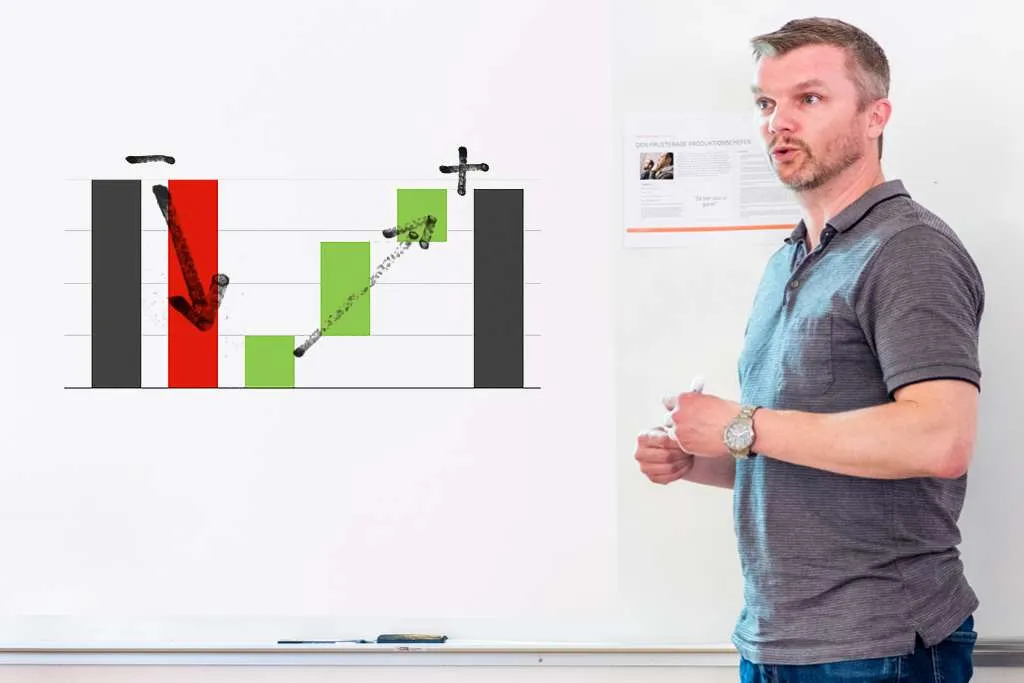
An OEE policy provides the team with standardised definitions for operating time, losses, and follow-up.
Two shifts can report different OEE figures even though production ran identically. One includes changeovers. The other excludes them from planned production time. Or different ideal cycle times are applied to the same part number.
An OEE policy helps the plant avoid such discrepancies. It defines what is measured, how it is calculated, and who is responsible for ensuring compliance with the rules. The document needs to cover the time model, item master data, events, quality, and procedures for modifications.
What is an OEE policy?
An OEE policy is a shared standard for the plant's measurement rules. It connects technical data capture with how production, maintenance, quality, and planning utilise the results.
The policy must be specific enough that two individuals classify the same event in the same way. It should make clear how altered measurement rules affect historical comparisons. Read the fundamentals of OEE calculation if you require a shared starting point.
Which rules need to be documented?
1. Scope and purpose
Specify which machines, lines, and processes are covered, the tracking period, and which operational decisions the metrics support. Also establish whether the metric applies to an individual machine or a connected line. An improvement on one machine does not automatically represent an improvement across the entire flow.
2. Planned production time
Detail how scheduled time translates into planned production time. Document the handling of breaks, unmanned hours, lack of orders, planned maintenance, cleaning, and changeovers. Time excluded from OEE must still be trackable when relevant to capacity planning.
3. Ideal cycle time per part number and machine
Define how the technically achievable run rate is established and who approves it. Distinguish ideal cycle time from average observed cycle time and planned cycle times that incorporate historical losses. If a sluggish actual cycle time is adopted as the ideal, speed loss vanishes from the metric without any actual production improvement.
4. Downtime, micro-stops, and speed losses
Define when downtime starts and ends, how micro-stops are thresholded, and how events are divided between availability and performance. If micro-stops are displayed separately in loss analysis, they must still only be counted once within OEE. Document how waiting for material, downstream blockages, and technical faults are distinguished.
5. Good count, scrap, and rework
Determine where in the process quality is measured, when a unit is counted as approved, and how scrap during start-up versus steady-state production is handled. Specify how rework and delayed quality dispositions are logged to ensure the same unit is not counted twice.
6. Reason codes and accountability
Operators require reason codes that reflect observable conditions at the machine. Establish when a reason code must be assigned, how uncoded events are followed up, and who maintains the code catalogue. Distinguish the registered stop symptom from a verified root cause: material starvation may be the visible stoppage, whereas the underlying cause requires investigation.
7. Change management and audit history
Appoint an owner for the policy. Document version numbers, revision dates, justifications, and affected assets. If shifts, ideal cycle times, or classification rules change, this must be transparent in longitudinal comparisons. A changed definition must never be reported as a production improvement.
Standardised rules across the entire calculation
The policy specifies what is included in time, speed, and quality.
Document every definition
Changeovers · maintenance · micro-stops · part number and machine · scrap and rework
Template for the plant's OEE policy
Copy the following points into a shared document and record your decisions. For each measurement rule, define the description, data source, a concrete example, and the assigned owner.
Document control: title, version, owner, and approval date.
Purpose and scope: assets, part numbers, reporting period, and decisions informed by the data.
Time model: scheduled time, planned production time, and treatment of each category of excluded time.
Production rate: ideal cycle time per part number and machine, baseline references, and change procedures.
Events: criteria for stop initiation, stop conclusion, micro-stops, changeovers, and speed losses.
Quality: inspection point, good count, start-up scrap, production scrap, and rework handling.
Reason coding: categorisation hierarchy, use of unassigned stops, and retrospective coding routines.
Data validation: verification routines, responsibilities, and handling of missing or suspect values.
Change log: details of modifications, rationale, authorised by, and effective date.
Validate the rules against real production events
Review a shift alongside an operator, production supervisor, maintenance technician, and quality engineer. Select a changeover, a brief stoppage, a material shortage, and a scrap occurrence. Verify that everyone can explain how these events are recorded and how they impact the metrics.
If answers diverge, clarify the underlying definitions. Then validate the measurement against observed durations and quantities before using the policy to establish targets or capacity decisions.
How is the policy used within the Good Solutions platform?
The policy defines the standard. System configuration and shop-floor routines must reflect it. The Good Solutions platform pairs automated machine events with operator reason codes, contextual comments, and production tracking by order and part number.
During operational onboarding, implementation includes configuration, data validation, and role-based training. Use your OEE policy as the shared baseline for this deployment. Read further on loss analysis and how measurement rules determine how you prioritise.
Frequently asked questions
Is an OEE policy the same as an OEE formula?
No. The formula outlines the mathematical calculation. The policy defines how the plant standardises and gathers the underlying inputs, as well as who governs the rules and data integrity.
Should all machines have the same ideal cycle time?
No. The ideal cycle time must reflect the specific part number and machine combination. It is the method used to define, document, and revise that value that must be standardised.
Can we compare OEE before and after changing the policy?
Comparisons must account for modified definitions and their specific impact on the numbers. Adjusting a threshold duration or ideal cycle time does not constitute a true manufacturing improvement.
Who should own the OEE policy?
Appoint a process owner capable of embedding the standards on the shop floor and coordinating revisions. Operators, production, maintenance, quality, and planning should all contribute to the standardisation process.
Read more
What is loss analysis and how do you use it in production?
Loss analysis involves breaking down production losses by cause, line, article, shift, and time, so that the factory knows exactly where capacity and money are being lost. The analysis is what makes an OEE figure useful: the figure shows that losses exist, while the analysis shows where, when, and why. It is the loss analysis that allows improvement efforts to be targeted at the most costly losses first, rather than those that are simply the most visible.
What is OEE and how is it calculated?
OEE consists of three multiplied subcomponents: Availability × Performance × Quality. For example, 85% availability, 98% performance, and 97.5% quality result in an OEE rate of 81%.
Take the first step towards increased productivity
Book a demo, and our experts will present a concrete plan to increase productivity, reduce resource use, and achieve profitability and sustainability targets.
Or call us and we will help you
© 2026 Good Solutions Sweden AB